Home /
What GPT-6 Astra chose to build
What three Astra agents built with room to choose: a string puzzle, a supply-chain experiment and a printable booklet, with their fixes and limits.
One of GPT-6 Astra's new Choice experiments has a shop place a bigger order and the factory's later order spike almost halve. Another makes you ring four bells with a piece of string, then work out how to get the string home. The third turns your writing into a little book made from one sheet of paper.
I asked for three independent experiments for Astra's first batch. This is the exercise I keep coming back to when a new model arrives: leave the subject open, let it build something, and put the result somewhere people can try it. Choice began as a way to find ideas; this batch went live on 4 September.
Three separate Astra agents ran at max reasoning, assigned something to play, explore or use. Under the brief developed during the GPT-5.6 experiments, a coordinating agent reviewed prototypes and requested fixes before polish. These three projects were not matched against another model.
The Order Echo: a bigger order, a smaller surge
The Order Echo starts with one busy shopping week. Customers buy twelve crates instead of four, then go back to buying four. The shop responds, then its wholesaler, then the depot and factory. By week twelve, the factory's orders peak at 76.8 crates.
Now switch on “Count crates already ordered”. The shop's first response rises from 12.5 crates to 14.5. The busy week raises its demand forecast and, with it, the amount it wants to have on order. Its outstanding orders fall short of that new target, so the added correction makes the first order bigger.
Later decisions account for orders still awaiting delivery, including those held up at a supplier. The factory's peak falls to 38.1 in week nine: a larger first shop order, but a much smaller surge further up the chain.
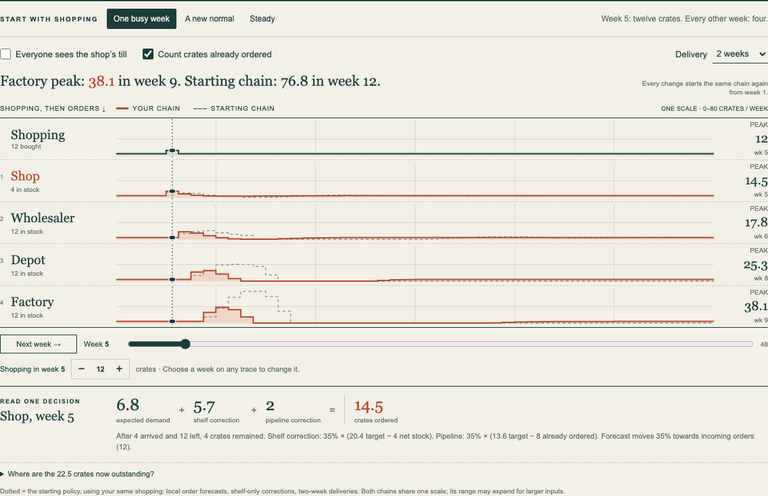
The interface lets you stop at a particular week and inspect the arithmetic behind an order. Both policies remain visible on the same scale, a change requested during prototype review. That makes the size of the difference visible instead of leaving you to compare two separately scaled charts.
The numbers belong to this particular teaching model: 48 weeks, continuous quantities of crates, selected replenishment rules and unlimited production upstream of the factory. They make delayed feedback inspectable; they do not forecast a real supply chain.
Loose End: the way back matters
In Loose End, the piece of string is both your means of moving and the thing that gets you into trouble. You guide its brass end around three pegs to ring four bells. There is no clock. The constraint is how much string you have left.
Going around a peg consumes some of that reach. Pointing back towards home does not necessarily free it, because the string still follows the route you took. Reaching the bells is only part of the task: you have to unwind the route and bring the string home too.
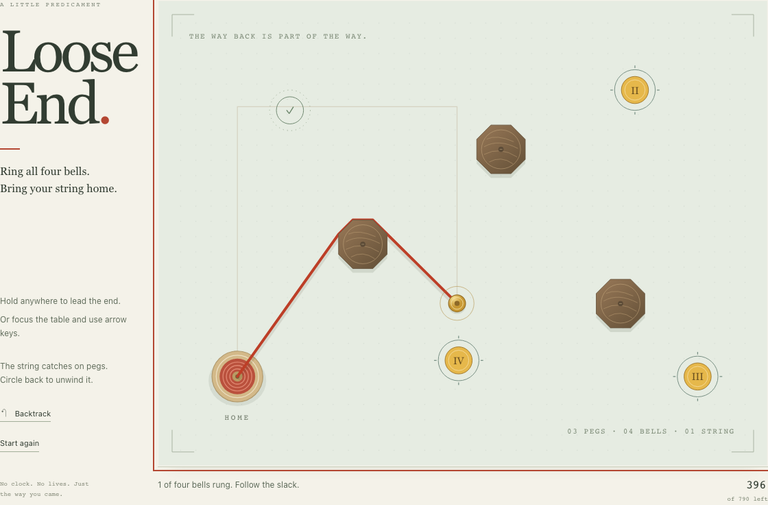
The prototype also had a less interesting obstacle: short arrow-key presses did nothing. The reviewer caught it and the builder fixed it. The recorded checks then exercised two winning strategies and retraced a long sequence of moves all the way home. This is one authored course with a planar taut-string model; friction, sag and stretchy rope are outside it.
Pocket Press: a book from one sheet
Pocket Press gives you a manuscript editor and an eight-page book. Write a cover, inside pages and back cover, then switch from reading order to the sheet you will print. It supports A4 and US Letter.
The print view looks wrong until you account for the fold. Across the top are pages 5, 4, 3 and 2, upside down; underneath are 6, 7, 8 and 1. Cut the central slit and fold the sheet, and those panels become the pages of the book.
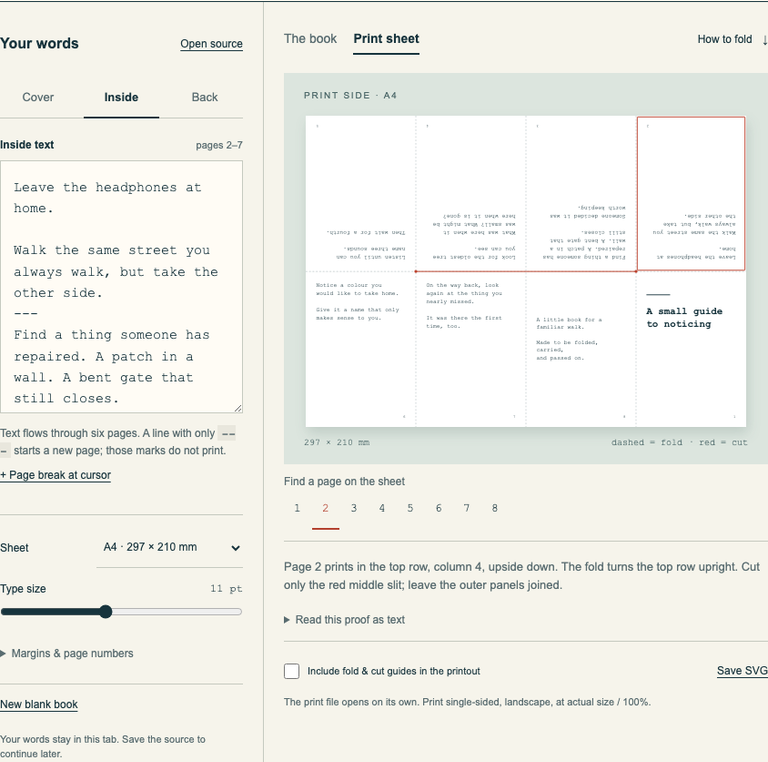
You can keep a print file, an SVG sheet and editable source. When the text overflows, printable exports are blocked, but the source can still be saved. The agent's browser checks downloaded the files, inspected the page geometry and text, and reopened the saved source to restore the manuscript. Review had also asked for clearer save controls and illustrated folding instructions.
The screenshots for this article exposed something those checks missed. In the 9 September capture at a 1,280-pixel browser width, the top and bottom of the sheet were cropped by its preview area. The narrower view above fits. Correct geometry in a saved file does not establish that its preview fits on screen.
The remaining check needs paper. No physical printing or folding was tested in this run. Pocket Press includes a numbered test sheet; printing and folding that would check the page order in the object it is meant to become.